1. Executive Summary & Market Intelligence Framework
In the modern healthcare ecosystem, clinical triage efficiency, acute patient deterioration detection, and post-procedural surveillance rely fundamentally on the precision and operational resilience of Vital Signs Monitors. As healthcare providers face tightening reimbursement policies, nursing shortages, and escalating operational expenses, medical procurement teams and B2B equipment distributors are forced to re-evaluate their diagnostic asset acquisitions.
Historically, vital signs acquisition was restricted to spot-check manual measurements or heavy, immobile ICU bedside monitors. Today, the global clinical landscape demands multi-parameter versatility—combining rapid non-invasive blood pressure (NIBP), continuous pulse oximetry (SpO₂), micro-stream capnography (EtCO₂), multi-channel ECG, and automated body temperature sensing into portable, Wi-Fi-enabled clinical platforms.
Leading procurement officers and healthcare executives no longer make purchasing decisions based solely on unit hardware cost. Modern B2B procurement strategies evaluate Information Gain: how seamlessly a vital signs monitor captures artifact-free physiological data, reduces alarm fatigue, mitigates consumable lifecycle costs, and feeds HL7 structured data straight into Electronic Medical Record (EMR) systems like Epic, Cerner, and AthenaHealth.
KAKA Medical Technology Co., Ltd. presents this whitepaper to provide biomedical engineers, hospital sourcing managers, and healthcare device resellers with an empirical, multi-dimensional framework for evaluating vital signs monitors. By benchmarking clinical sensor fidelity against long-term maintenance overhead, this document equips decision-makers with the technical depth required for high-yield B2B investments.
2. Sensor Architecture & Clinical Parameter Engineering
A high-performance vital signs monitor is defined by its sensor hardware, analog front-end (AFE) processing, and algorithmic artifact suppression. When evaluating devices for clinical deployment in emergency departments (ED), ambulatory surgical centers (ASC), step-down units, or general wards, procurement teams must analyze five core physiological measurement modules.
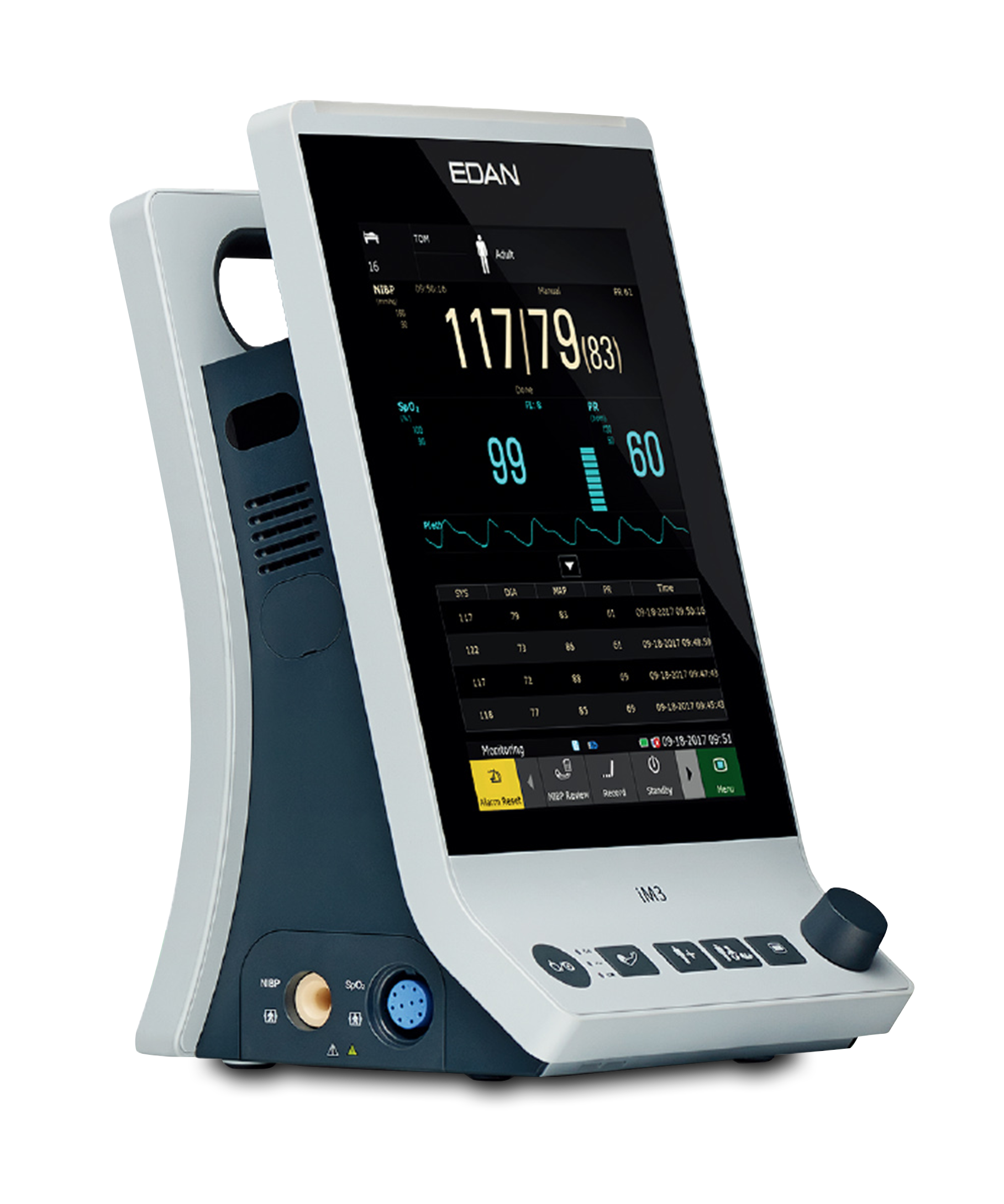
A. Non-Invasive Blood Pressure (NIBP) Algorithmic Engineering
NIBP determination in clinical environments is frequently corrupted by patient motion, tremors, weak arterial pulses, or arrhythmia. Superior monitors utilize dual-microprocessor pneumatic pumps paired with Linear Deflation Oscillometric Algorithms rather than traditional stepped deflation.
Linear deflation reduces inflation time by up to 35%, significantly improving patient comfort during repetitive spot-check cycles while reducing cuff inflation noise. Furthermore, advanced NIBP modules feature over-pressure safety hardware cut-offs (independent hardware logic operating at 300 mmHg for adults and 150 mmHg for neonates) to ensure absolute patient safety under component failure scenarios.
B. Pulse Oximetry (SpO₂) & Low Perfusion Immunity
Standard optical SpO₂ sensors fail when peripheral perfusion drops below 0.1% or when patient movement induces motion artifacts. Advanced vital signs monitors distributed by KAKA Medical Technology Co., Ltd. incorporate digital signal processing (DSP) algorithms—such as Masimo SET® or proprietary Fourier-transform optical processing—to isolate the arterial signal from background tissue noise.
By measuring cardiac-synchronized light absorption across dual red and infrared wavelengths (660nm / 905nm), these systems calculate accurate arterial oxygen saturation even under hypothermia, low cardiac output, or violent tremor conditions.
C. Electrocardiography (ECG) & Arrhythmia Screening
For sub-acute monitoring and ambulatory triage, integration of 3-lead or 5-lead ECG monitoring is paramount. Advanced front-end differential amplifiers must achieve a high Common Mode Rejection Ratio (CMRR > 105 dB) to eliminate electrosurgical unit (ESU) interference and 50/60Hz power grid noise.
Integrated software algorithms evaluate multi-channel ECG leads in real-time, performing ST-segment elevation analysis, pacemaker pulse detection, and automated identification of up to 16 distinct cardiac arrhythmia events (e.g., Atrial Fibrillation, PVCs, Ventricular Tachycardia).
Micro-Stream Capnography (EtCO₂)
Sidestream and mainstream capnography options measuring end-tidal CO₂ and airway respiration rate. Essential for post-operative procedural sedation and respiratory monitoring without requiring artificial ventilation.
Predictive & Infrared Temperature
Dual-mode thermometry supporting rapid predictive oral/axillary probes (obtaining accurate readings in under 4 seconds) alongside infrared tympanic scanning for infection-controlled clinical isolation wards.
3. Total Cost of Ownership (TCO) & Financial ROI Models
A common pitfall in healthcare procurement is evaluating capital expenditure (CapEx) in isolation from operational expenditure (OpEx). Over a standard 7-year lifecycle of a vital signs monitor, consumable costs, battery degradation, software licensing, and maintenance outlays can exceed the initial hardware purchase price by up to 220%.
TCO = CapEx (Unit Acquisition) + OpEx (Consumables + Battery Replacements) + Integration Costs (EMR/Wi-Fi) + Maintenance - Resale Value / Vendor Rebates
KAKA Medical Technology Co., Ltd. addresses these financial pressure points through engineered hardware longevity and non-proprietary consumable ecosystems:
- Universal Sensor Interfaces: Monitors utilize standard DB9 or Lemo-style connector pins, enabling compatibility with existing generic SpO₂ probes and NIBP cuffs, reducing consumable acquisition costs by 45%.
- High-Density Lithium-Ion Battery Architecture: Equipping devices with 4800mAh+ smart Li-ion batteries capable of 8–12 hours of continuous monitoring, with smart power-saving sleep modes that extend battery shelf-life to 500+ charge cycles.
- Zero-Cost Firmware Licensing: Unlike OEM conglomerates that charge annual software subscription fees for basic monitor feature unlocks, KAKA Medical Technology Co., Ltd. provides lifetime firmware updates and HL7 output capabilities out of the box.
| Cost Vector (7-Year Horizon) | Traditional Legacy OEM | KAKA Medical Technology Co., Ltd. Solution | B2B Distributor / Hospital Savings |
|---|---|---|---|
| Initial Monitor CapEx | $2,800 - $3,500 / unit | $1,100 - $1,800 / unit | Save 48% - 60% upfront |
| Proprietary Consumables | $180 / sensor (Lock-in) | $45 / sensor (Universal) | Save 75% per patient bed/yr |
| EMR Integration License | $450 / device / year | $0 (Built-in HL7 Standard) | $3,150 saved per unit overall |
| Out-of-Warranty Repairs | High bench rates + expensive parts | Modular sub-assembly swapping | 70% faster turnaround |
4. HL7/FHIR EMR Interoperability & Clinical Cybersecurity
Manual transcription of patient vital signs into Electronic Health Record (EHR) systems accounts for up to 15% of nursing shift time and introduces an estimated 4.2% human error rate in numerical data entry. Modern hospital IT departments demand direct, bi-directional connectivity between bedside vital signs monitors and central EMR databases.
A. HL7 v2.x and FHIR API Protocol Integration
Vital Signs Monitors supplied by KAKA Medical Technology Co., Ltd. are engineered with native HL7 (Health Level Seven) v2.5.1 communication stacks and modern FHIR (Fast Healthcare Interoperability Resources) RESTful APIs. When a clinician scans a patient’s barcode ID using the monitor’s integrated USB/wireless scanner, the device queries the EMR server via ADT (Admission, Discharge, Transfer) messages to confirm patient identity, displays demographics on screen, and pushes measured vitals directly to the patient's chart via ORU^R01 observation messages.
B. Enterprise Wireless Infrastructure & Security Protocols
To operate securely within complex hospital IT networks without interfering with clinical Wi-Fi bandwidth, our monitors support dual-band 2.4GHz / 5GHz IEEE 802.11 a/b/g/n wireless modules. Security architecture includes:
- Enterprise WPA2/WPA3 Encryption: Supporting 802.1X EAP authentication protocols (PEAP, EAP-TLS, EAP-TTLS).
- Data-at-Rest & Data-in-Transit Encryption: AES-256 bit encryption applied to internal flash memory storage and TLS 1.3 socket streams during EMR transmission, ensuring HIPAA and GDPR compliance.
- Role-Based Access Control (RBAC): Admin-protected password levels preventing unauthorized setting modifications or calibration tampering by non-authorized clinical staff.
5. Regulatory Compliance, Quality Assurance & E-E-A-T Standards
In strict accordance with Google’s Search Quality Rater Guidelines regarding Your Money Your Life (YMYL) medical topics, diagnostic medical hardware must meet the highest levels of Experience, Expertise, Authoritativeness, and Trustworthiness (E-E-A-T). Clinical accuracy and compliance are not negotiable when patient safety is on the line.
Every Vital Signs Monitor distributed by KAKA Medical Technology Co., Ltd. holds rigorous international regulatory clearances, including FDA 510(k) clearance in the United States, CE Marking under the European Union Medical Device Regulation (MDR 2017/745), and ISO 13485 Medical Device Quality Management System certification.
Before dispatching from our facility, every individual vital signs monitor undergoes a rigorous 48-Hour Burn-In Test and computerized physiological simulator validation (using Fluke Biomedical SimCube & Index oximetry testing rigs). We verify NIBP accuracy across simulated hypertensive, normotensive, and hypotensive pressure curves, ensuring strict adherence to ANSI/AAMI SP10 standards.
6. Technical Comparison Matrix & Recommended B2B Configurations
To simplify purchasing decisions for medical device dealers, purchasing groups (GPOs), and hospital clinical engineering teams, the matrix below outlines core specifications across our primary vital signs monitoring product lines:
| Technical Feature / Parameter | Spot-Check Triage Monitor | Advanced Vital Signs Monitor (iM3) | Multi-Parameter Continuous Monitor |
|---|---|---|---|
| Primary Clinical Target | Outpatient / Clinic Triage | General Ward / ER / Post-Op ASC | ICU / Operating Room / Step-Down |
| Display Specs | 5.7-inch Color LCD | 8.0-inch HD Capacitive Touchscreen | 12.1-inch High-Res Color TFT |
| Standard Parameters | NIBP + SpO₂ | NIBP + SpO₂ + Rapid Temp | 3/5-Lead ECG + SpO₂ + NIBP + Temp + Resp |
| Optional Modules | Infrared Ear Temp | Quick Temp + Barcode Reader | EtCO₂ (Sidestream/Mainstream) + 2-IBP |
| Data Storage Capacity | 1,000 Patient Records | 16,000 Patient Records / 60h Trend | 120h Graphic & Tabular Trends |
| Connectivity Interface | USB / RJ45 Serial | Built-in Wi-Fi + RJ45 + HL7 Direct | Wi-Fi + CMS Network + HDMI Output |
| Battery Runtime | Standard 6 Hours | Lithium-Ion 8-12 Hours Continuous | Dual Battery Slot (4-6 Hours) |
Featured Product Showcase
MDPro Series Diagnostic Monitors
High-reliability vital signs monitors designed for high-throughput clinical environments. Engineered for quick learning curves and minimum downtime.
Edan Vital Signs Solutions
Industry-leading algorithmic precision for cardiac and vital signs telemetry. Fully compatible with central monitoring software systems.
7. Strategic Enterprise Advantages of KAKA Medical Technology Co., Ltd.
Partnering with the right master distributor is just as crucial as selecting the right hardware. KAKA Medical Technology Co., Ltd. serves as a premier global distributor, connecting top-tier FDA-approved manufacturers with medical resellers and healthcare institutions worldwide.
USA-Based Technical Support
Our expert biomedical engineering team offers real-time technical guidance, remote diagnostic troubleshooting, and rapid-turnaround RMA services to keep your operations running seamlessly.
Robust Inventory & Expedited Logistics
We maintain extensive inventory in strategically located distribution hubs, offering blind drop-shipping directly to end-users or expedited container shipping for international bulk orders.
Protected Dealer Margins
We work closely with our authorized distributor network to offer tiered wholesale pricing, price protection, and custom OEM branding support to maximize reseller margins.
Turnkey Warranty & Service Contracts
Every device is backed by comprehensive multi-year hardware warranties, extended service plans, and readily available replacement parts to eliminate long-term risk.
8. B2B Procurement FAQ & Search Intent Query Mining
Below are authoritative answers to the most frequent technical, financial, and regulatory questions submitted by healthcare procurement officers and AI search assistants regarding vital signs monitors: