[email protected] Mon – Fri  8:00 AM – 5:00 PM PST
Industry Insights & Knowledge Base

Medical Technology Insights & Clinical Guides

Explore expert articles, diagnostic device guides, and industry news from KAKA Medical Technology Co., Ltd.

Authorized Dealer Program

Latest Trends in Diagnostic Medical Equipment

Stay informed on FDA approvals, technological advancements, and distribution solutions worldwide.

Clinical Resources

Expert Clinical Device & Distribution Guides

Learn how KAKA Medical Technology Co., Ltd. delivers clinically proven diagnostic solutions at global scale.

0%

China Top Diagnostic Medical Doppler Manufacturers is a useful starting point for buyers comparing imaging suppliers, but the label alone says little about clinical performance. Diagnostic Medical Dopplers convert moving blood into measurable signals, helping clinicians assess flow direction and velocity. In a clinic, that may mean checking a fetal heartbeat, examining limb circulation, or evaluating cardiac blood flow. Probe design, signal processing, portability, and service support all matter. So does the quality of training.

The market is growing, but the figures need careful interpretation. Grand View Research estimated the global ultrasound devices market at about USD 8.8 billion in 2023, with further growth projected through 2030. This is a broad ultrasound category, not a Doppler-only estimate. It provides context, not a direct measure of Chinese manufacturers’ sales. Cardiologist Harvey Feigenbaum’s widely repeated description of echocardiography as “the stethoscope of the cardiologist” captures its clinical role. It also points to a limitation: the instrument supports judgment; it does not replace it. Specs can mislead.

This guide will compare Chinese manufacturers through practical criteria, including Doppler modes, probe options, image quality, certifications, production capabilities, and after-sales support. Buyers should verify claims against product documentation and local clinical needs. A polished brochure cannot demonstrate dependable performance at a patient’s bedside. No ranking can settle that.
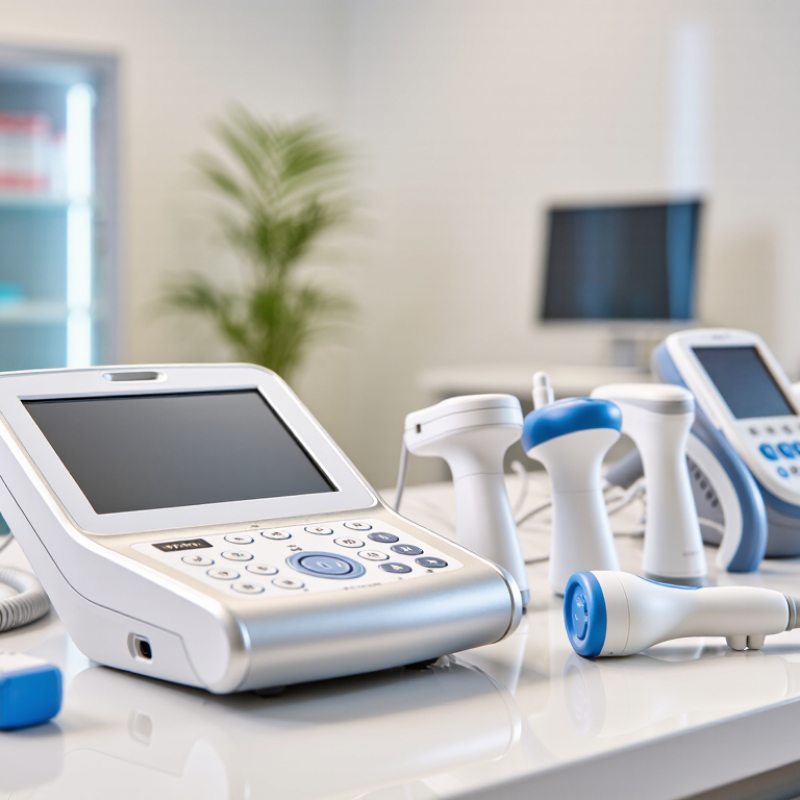
China Top Diagnostic Medical Doppler Manufacturers

Types of Diagnostic Medical Doppler Systems Manufactured in China

Diagnostic medical Doppler systems manufactured in China cover several clinical settings. Cart-based color Doppler scanners combine grayscale imaging with color flow maps. Clinicians use them to assess blood-flow direction and speed in abdominal, cardiac, and vascular examinations. Compact portable systems bring similar functions to bedside rooms and smaller clinics. Handheld Dopplers are lighter still. They can help detect peripheral pulses, though they do not provide the same anatomical detail as imaging systems.

Vascular Doppler units support examinations of arteries and veins, including measurements of flow patterns. Transcranial Doppler systems use ultrasound through specific skull windows to evaluate blood flow in cerebral vessels. Fetal Dopplers are designed to detect fetal heart activity during pregnancy; they are not substitutes for a full diagnostic examination. Some ultrasound platforms offer pulsed-wave and continuous-wave Doppler, alongside duplex or triplex imaging. The exact combination varies by system.

For buyers, useful comparisons include probe options, display size, battery life, measurement tools, and image storage. A crowded screen can make a routine reading harder. Small details matter. Specifications should be checked against the intended examination and local clinical workflow, rather than judged by feature count alone. Product descriptions may sound similar, but probe performance and operator training can change the practical experience. That distinction deserves closer review.

Core Technologies Used in Diagnostic Doppler Equipment

China Top Diagnostic Medical Doppler Manufacturers

Core Technologies Used in Diagnostic Doppler Equipment

Diagnostic Doppler systems turn returning sound waves into information about blood flow. A transducer sends short pulses into tissue; moving cells shift the returning frequency. The FDA describes typical diagnostic ultrasound frequencies as 2–18 MHz. Lower frequencies reach deeper vessels, while higher frequencies can show finer detail near the skin.

Different Doppler modes answer different questions. Color Doppler overlays flow direction and relative velocity on a grayscale image. Pulsed-wave Doppler samples a chosen location, while continuous-wave Doppler measures high velocities along the beam without pinpointing their depth. Power Doppler is sensitive to weak flow, but provides less directional information. These methods depend on beamforming, filtering, and signal processing—not just the probe.

Small settings matter. The angle between the beam and vessel can affect measured velocity; poor alignment may distort the result. AIUM practice guidance emphasizes appropriate technique and image documentation, while FDA guidance provides the frequency context. For manufacturers, reliable probes, stable calibration, and usable controls are practical priorities. A bright color map can look convincing. It is not proof of accurate flow measurement, and operators still need to check the waveform and clinical context.

Profiles of Major Chinese Diagnostic Doppler Manufacturers

China’s diagnostic Doppler manufacturers vary in product focus, production scale, and clinical support. Some develop compact systems for primary-care rooms, where a small footprint and quick setup matter. Others build cart-based ultrasound platforms with Doppler functions for hospital departments. Their profiles are best judged by what they can document, not by broad claims.

A careful company profile should describe probe options, imaging modes, user training, and service arrangements. For example, a buyer may ask how clearly a vascular flow pattern appears on a standard monitor, or how long routine maintenance takes. Manufacturing records and quality-management documentation also help explain how products are developed and checked. Details matter.

Capabilities differ. Not every supplier offers the same depth of engineering support, and export experience alone does not prove clinical suitability. Buyers can request demonstrations using representative examination settings, then compare image quality, workflow, and service response.

Ask for evidence. Product specifications may sound complete, yet practical details can remain unclear. That gap deserves attention. A balanced profile should note both strengths and limits, while encouraging independent checks against local clinical needs.

Manufacturing Capabilities and Quality Standards

Manufacturing Capabilities and Quality Standards

China’s diagnostic Doppler manufacturers need more than efficient assembly lines. WHO’s 2017 Global Atlas of Medical Devices describes roughly 1.5 million medical devices across about 10,000 types. That diversity makes disciplined design controls essential. Doppler systems must translate weak returning echoes into stable flow measurements, even when probes move or patient conditions vary.

A capable factory should document probe matching, acoustic-output checks, signal processing, and software version control. Production teams can test units with flow phantoms, checking velocity readings, color-flow consistency, and image noise. They should also record component lots and link each finished system to inspection results. ISO 13485 provides a quality-management framework; IEC 60601-1 and IEC 60601-2-37 address electrical safety and ultrasonic diagnostic equipment. Standards guide testing, but do not prove every device performs equally well.

Ask how manufacturers handle failed tests, supplier changes, and post-market feedback. A certificate alone is not enough. Review sample records, calibration methods, and corrective-action procedures. Practical audits may reveal gaps that polished documents hide. There is room for improvement, even in mature factories: phantom testing cannot fully reproduce every clinical setting, so field feedback still matters.

Key Factors for Evaluating Chinese Doppler Suppliers

When evaluating Chinese Doppler suppliers, look beyond a smooth product demonstration. Ask how the system performs across the intended examinations, not just on one carefully chosen scan. Check color-flow stability, image clarity at different depths, and whether the controls are practical with gloves on. Small details matter.

Request specifications for probe types, operating frequencies, software options, and compatibility with the proposed system configuration. Then compare those details with your department’s needs. Ask for quality-control procedures, inspection records, and examples of how production changes are documented. A polished showroom demo can still hide uneven performance between units. One successful scan is not enough evidence; treating it as proof would be too optimistic. Ask for evidence.

Supplier evaluation should also cover training, warranty terms, spare-part availability, and response times for technical support. Confirm what is included in the quotation and what may incur additional costs, such as installation or software updates. Review relevant certifications and product documentation for the markets where the equipment will be used. If possible, arrange a structured evaluation using representative workflows and clear acceptance criteria. I would still leave room for uncertainty: a short evaluation cannot reveal every issue that may emerge after months of use. Keep written records of questions, answers, and test results so purchasing decisions rest on verifiable details, not presentation alone.

China Top Diagnostic Medical Doppler Manufacturers - Key Factors for Evaluating Chinese Doppler Suppliers

A practical supplier evaluation checklist for diagnostic medical Doppler systems. Verify each item against the exact device model, intended use, target market, and current supporting documents.

Evaluation Factor What to Assess Evidence to Request How to Evaluate
Regulatory authorization Whether the device’s intended use, model, configuration, and classification match the markets where it will be sold. Applicable market authorization or registration details; device labeling and instructions for use; model and intended-use information. Check the authorization with the relevant regulator or official database where available. Confirm that it covers the offered model and intended use.
Quality management system Whether the manufacturing site operates a documented medical-device quality system and whether its scope covers the relevant products and activities. Current quality-system certificate, including scope, issuing body, covered sites, and validity; audit or quality-system information where available. Verify certificate status with the issuing organization and confirm that the manufacturing location and product scope are relevant.
Doppler functionality Supported modes and intended clinical applications, such as continuous-wave Doppler, pulsed-wave Doppler, color Doppler, or power Doppler, as applicable to the system. Model-specific specifications, user manual, supported probe list, and demonstration using representative clinical scenarios. Compare the offered configuration with the required examinations. Confirm that each stated mode is available on the specific model and probe combination.
Performance and image quality How well the system displays and measures relevant flow information under the intended examination conditions. Technical specifications, sample images or clips, measurement descriptions, and documented verification or validation information. Use a consistent evaluation protocol and representative cases. Review image and spectral display quality, measurement workflow, and repeatability for the intended use.
Electrical safety and EMC Safety and electromagnetic compatibility documentation applicable to the device configuration and target market. Test reports or certificates referencing applicable standards, such as IEC 60601-1 for basic safety and essential performance and IEC 60601-1-2 for electromagnetic disturbances; where applicable, documentation for diagnostic ultrasonic equipment under IEC 60601-2-37. Check the exact model, accessories, test laboratory, report date, and standard editions. Confirm that the documents apply to the configuration being purchased.
Acoustic output information Availability of relevant acoustic-output information and controls for the intended diagnostic use. User-manual information on acoustic output, applicable display indices, and supporting technical documentation. IEC 62359 describes methods for determining thermal and mechanical indices related to diagnostic ultrasound fields. Confirm that the information is appropriate to the device and its intended use, and that operators can access the relevant output information during use.
Software and risk management Documented software lifecycle processes, risk controls, update handling, and management of software-related changes. Relevant development and risk-management documentation; software version and release information; change-control and update procedures. IEC 62304 addresses medical-device software lifecycle processes, and ISO 14971 addresses medical-device risk management. Review how software changes are assessed, tested, approved, and communicated, particularly when they affect clinical functions or device performance.
Usability and operator workflow Whether controls, on-screen information, measurements, and instructions support the intended users and use environments. Instructions for use, training materials, usability information, and a hands-on demonstration. IEC 62366-1 provides a process for applying usability engineering to medical devices. Have representative users complete common tasks and review setup, examination workflow, measurement steps, and error-prevention features.
Manufacturing and traceability Consistency of production, component control, product identification, and handling of nonconforming products and complaints. Manufacturing-site details, device and batch identification information, inspection and release procedures, and complaint or corrective-action processes. Confirm that the supplier can trace delivered units and explain how quality issues, product changes, and corrective actions are managed.
Service and technical support Availability of installation, user training, maintenance, repairs, spare parts, and technical assistance in the destination market. Service coverage details, training plan, maintenance recommendations, spare-parts arrangements, and support contact or escalation process. Clarify response arrangements, service responsibilities, warranty coverage, and the availability of qualified support where the system will be installed.
Export documentation and labeling Whether documentation, labeling, language, and shipping records meet the destination market’s requirements. Sample labels and instructions for use, packaging information, export documents, and market-specific documentation where applicable. Review requirements with the importer or regulatory specialist. Ensure documents identify the correct model, manufacturer, intended use, and configuration.
Commercial and lifecycle terms Total ownership considerations, including included accessories, software options, consumables if applicable, warranty, and future support. Itemized quotation, configuration list, warranty terms, delivery terms, training scope, and written terms for upgrades or ongoing support. Compare equivalent configurations and document exclusions, recurring costs, delivery responsibilities, and post-warranty service arrangements.

Evaluation note: Standards, registrations, and market requirements depend on the device, intended use, and destination. Confirm current applicability with the relevant regulator or a qualified regulatory professional; a certificate or test report should not be assumed to cover every model or market.

FAQS

What types of diagnostic Doppler systems are commonly available?

Options include cart-based color scanners, portable units, handheld Dopplers, vascular systems, and transcranial systems. Their features vary.

How do cart-based and portable Doppler systems differ?

Cart-based scanners combine grayscale images with color flow maps. Portable systems bring similar functions to bedside rooms and smaller clinics.

What can a handheld Doppler show?

It can help detect peripheral pulses. It offers less anatomical detail than an imaging system.

Are fetal Dopplers a substitute for a full diagnostic examination?

No. They detect fetal heart activity, but do not replace a full diagnostic examination. That distinction matters.

Which details should buyers compare?

Check probe options, display size, battery life, measurement tools, and image storage. A crowded screen can hinder routine readings.

How can a factory check Doppler performance?

Teams can use flow phantoms to check velocity readings, color-flow consistency, and image noise. Real clinical conditions are harder to reproduce.

What quality and safety standards are relevant?

ISO 13485 covers quality management. IEC 60601-1 and IEC 60601-2-37 address electrical safety and ultrasonic diagnostic equipment.

Why review records and corrective-action procedures?

They can show how failed tests, supplier changes, and feedback are handled. A certificate alone is not enough. I may still miss a practical gap.

Conclusion

This article explores the range of Diagnostic Medical Dopplers manufactured in China, including systems designed for vascular assessment, fetal monitoring, and general clinical use. It explains the core technologies behind these devices, such as Doppler signal processing, probe design, imaging integration, and software that helps present measurements clearly for clinical evaluation.

The article also outlines common manufacturing capabilities and quality practices, including product testing, production consistency, and compliance with relevant quality standards. It offers a practical framework for evaluating Chinese suppliers by considering technical performance, product range, manufacturing experience, customization options, after-sales support, and documentation. Together, these topics help readers compare suppliers and understand the capabilities involved in producing reliable diagnostic Doppler equipment.

Oliver

Oliver

Oliver is a dedicated marketing professional with a deep expertise in our company’s product offerings. His passion for marketing is matched only by his commitment to sharing valuable insights with our audience. As a key contributor to our professional blog, Oliver consistently produces engaging and......