[email protected] Mon – Fri  8:00 AM – 5:00 PM PST
Industry Insights & Knowledge Base

Medical Technology Insights & Clinical Guides

Explore expert articles, diagnostic device guides, and industry news from KAKA Medical Technology Co., Ltd.

Authorized Dealer Program

Latest Trends in Diagnostic Medical Equipment

Stay informed on FDA approvals, technological advancements, and distribution solutions worldwide.

Clinical Resources

Expert Clinical Device & Distribution Guides

Learn how KAKA Medical Technology Co., Ltd. delivers clinically proven diagnostic solutions at global scale.

0%

Buying a portable spirometer can seem simple until accuracy, workflow, and patient comfort enter the decision. Portable Spirometers vary in sensors, software, mouthpiece design, battery life, and cleaning requirements. A compact device is not automatically dependable. That distinction matters.

This guide shares seven practical tips for comparing models through a clinical and practical lens. It considers published performance data, manufacturer documentation, and real-world testing routines. Look for clear measurements of FEV1, FVC, and quality indicators, rather than attractive screen claims. A reliable unit should support repeatable testing and explain poor efforts. It should also suit the people using it, from children to older adults. Small details matter. A stiff mouthpiece or confusing prompt can weaken an otherwise capable test.

The discussion examines calibration checks, connectivity, data security, warranty support, and regulatory status in your market. Requirements differ between home monitoring, primary care, occupational screening, and specialist assessment. Do not treat one feature as the final answer. A device may work well in a clinic yet feel inconvenient during travel. No checklist is perfect. Even experienced buyers can overlook software updates or replacement costs. Confirm device instructions with qualified healthcare professionals before using results for clinical decisions. These tips aim to make comparison clearer, while leaving room for careful judgment.
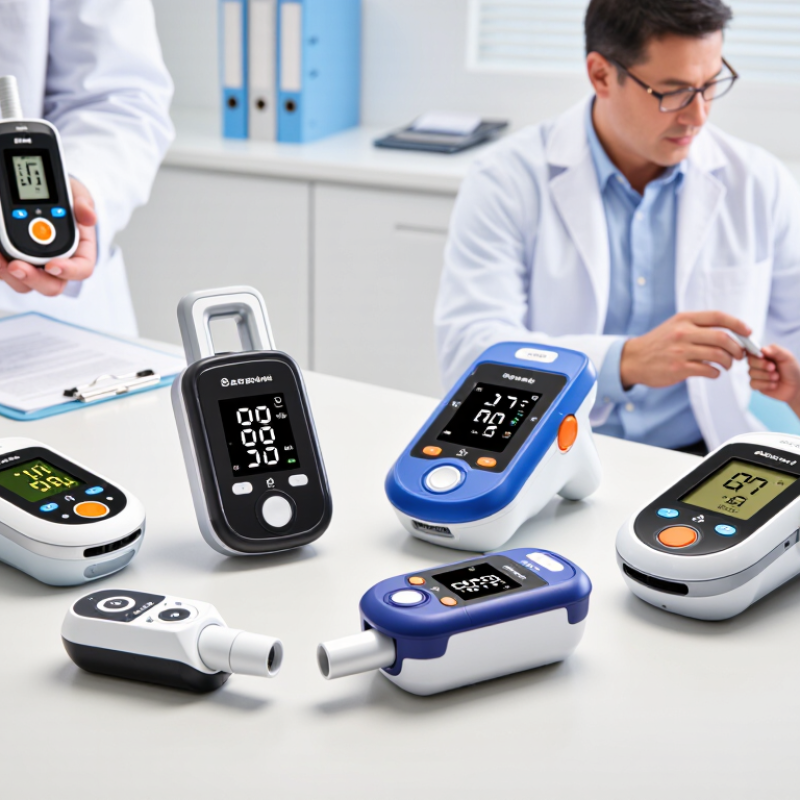
7 Tips for Buying the Best Portable Spirometers

Define Use Cases with FEV₁, FVC, and FEV₁/FVC Measurement Needs

The best portable spirometer depends on the question it must answer. For routine screening, FEV₁ and FVC may reveal reduced airflow or limited lung volume. For obstruction assessment, the FEV₁/FVC ratio is essential. A device displaying only one value is rarely enough.

Consider the setting carefully. A respiratory clinic may need repeatable measurements, predicted values, and quality grades. A home user may need simple prompts, clear results, and reliable data sharing. FEV₁ tracks forced airflow during the first second. FVC records the total forced breath. Their ratio helps clinicians judge airflow limitation, but it should not stand alone. Age, height, symptoms, technique, and reference equations also matter.

Look for documented accuracy, repeatability, calibration guidance, and coaching features. A quiet room, a firm mouth seal, and a full inhalation can change the reading. Small mistakes matter. In practice, users often blow too early or stop too soon. I have found that a convenient screen can create false confidence. The device should flag poor efforts and encourage repeat testing. Results should be reviewed by a qualified healthcare professional, especially when values decline or symptoms worsen. A portable spirometer supports assessment; it does not replace clinical judgment, lung-function testing, or patient history.

Verify ATS/ERS 2019 Compliance and ISO 26782 Accuracy Standards

Buying a portable spirometer requires more than checking screen size or battery life. Verify explicit alignment with the ATS/ERS 2019 technical standard and ISO 26782. The ATS/ERS standard requires adult FEV1 and FVC repeatability within 150 mL, while children aged six or younger require 100 mL. Ask for validation documents, not vague “clinical-grade” language.

Test accuracy with a calibrated 3-L syringe before regular use. ISO 26782 commonly evaluates volume accuracy against limits of ±3% or 50 mL, whichever is greater. Check flow accuracy, leak resistance, software updates, and temperature compensation.

A device may pass in a laboratory yet behave differently beside a cold clinic window. That matters.

Watch the maneuver. Confirm clear prompts, real-time curves, automatic acceptability checks, and exportable raw data. Compare repeated blows from the same operator and patient. Poor coaching can imitate poor lung function.

Keep calibration logs and inspect the mouthpiece connection weekly. Some purchasing teams, including mine, have focused too much on compact design. That was a mistake. Standards, traceable testing, and usable records deserve more attention than attractive packaging. Never accept a certificate without checking its test scope, date, and measurement conditions.

Prioritize Repeatability Within 150 mL for FEV₁ and FVC Results

7 Tips for Buying the Best Portable Spirometers

Prioritize repeatability within 150 mL for FEV₁ and FVC results. This threshold helps show whether a reading reflects the patient’s effort or device variation. Ask for quality reports from repeated tests, not only advertised accuracy. A reliable spirometer should record several acceptable blows and display the differences clearly. Small details matter.

Check whether the device supports proper coaching and detects coughs, early stops, leaks, and weak starts. These features protect test quality, but they cannot replace trained supervision. Confirm that the flow sensor remains stable after repeated use and that calibration checks are simple. Daily testing should not feel like a laboratory project.

Review the screen, battery life, data export, and cleaning process before purchase. A bright display helps when testing patients in busy rooms or outdoor clinics. Results should include effort time, flow curves, FEV₁, and FVC, not just a pass label. Confirm that software updates preserve older records. That point is easy to miss.

A practical trial can reveal more than a brochure. Test the same person several times under consistent conditions, then compare FEV₁ and FVC differences. If either value varies beyond 150 mL without a clear clinical reason, investigate the device, technique, and patient effort. The limit is useful, but not absolute for every patient. Children, frail adults, and people with severe obstruction may need careful interpretation. A perfect number is not always a trustworthy result.

7 Tips for Buying the Best Portable Spirometers - Prioritize Repeatability Within 150 mL for FEV₁ and FVC Results

No. Buying Tip Recommended Data Dimension Practical Benchmark How to Evaluate It
1 Prioritize repeatability FEV₁ and FVC repeatability The difference between the two largest acceptable FEV₁ values and the two largest acceptable FVC values should be 150 mL for patients with an FVC of at least 1.0 L. Review several forced expiratory maneuvers from the same session and confirm that the device clearly reports the best values and the repeatability difference.
2 Check measurement accuracy Volume and flow accuracy Look for performance consistent with current spirometry standards, including volume accuracy of approximately ±2.5% of reading or ±50 mL, whichever is greater. Request the technical specification, calibration procedure, and verification records rather than relying only on marketing claims.
3 Verify the flow range Peak expiratory flow and dynamic range A suitable device should measure the expected adult and pediatric range without clipping or excessive loss of accuracy; a flow range reaching at least 0–14 L/s is commonly used for full-range spirometry. Compare the stated range with the intended patient population and check whether accuracy is maintained at both low and high flows.
4 Assess maneuver quality controls Start-of-test, end-of-test, cough, leak, and hesitation detection The device should flag common quality problems and provide expiratory time, volume-time, and flow-volume information for review. Confirm that the software identifies unacceptable efforts instead of automatically treating every maneuver as valid.
5 Evaluate calibration and quality assurance Calibration verification and quality-control workflow Prefer a system that supports a 3.00 L calibration syringe and documents verification results; daily verification is commonly required in clinical quality-control programs. Check whether calibration records, operator identification, date, time, and pass/fail results can be stored or exported.
6 Choose practical portability Weight, battery life, display, and data transfer For mobile use, a compact unit under approximately 1 kg, rechargeable power, readable results, and secure USB or wireless export can improve workflow. Test the device in the actual setting and confirm that data remain available when internet access is limited.
7 Review usability and infection control Mouthpiece design, cleaning, filters, and operator guidance Select disposable or easily replaceable patient-contact parts, clear coaching prompts, and a cleaning process compatible with the intended clinical environment. Confirm the cost and availability of consumables, cleaning instructions, and whether the workflow reduces cross-contamination risk.
Reference note: The 150 mL repeatability target applies to the two largest acceptable FEV₁ and FVC measurements in a test session for patients with FVC ≥ 1.0 L. Interpretation should follow the applicable current spirometry standard, local clinical policy, and trained professional review.

Compare Portability, Battery Life, Calibration, and Measurement Range

Choosing a portable spirometer starts with the route it must travel. A clinic device may tolerate a cart; a community team needs a case, secure probe, and clear screen. Weight matters, but cable clutter and fragile connectors matter more. WHO’s World Health Statistics 2024 reports 3.5 million COPD deaths in 2021, reinforcing the need for dependable testing beyond hospitals. Battery claims deserve practical testing. Compare rated operating hours, charging time, low-battery behavior, and performance after repeated sessions. A replaceable battery can help during outreach visits, although it may add weight. I would test one full day of measurements, not trust a box label. That is imperfect, but realistic.

Calibration protects clinical confidence. The ATS/ERS 2019 technical standard recommends regular volume verification with a calibrated 3-liter syringe. It specifies accuracy within ±3.5% for volume measurements. Look for automatic reminders, calibration logs, and simple leak checks. Measurement range also matters. The same standard describes flow measurement from 0 to 14 L/s and volumes up to 8 liters. It recommends volume accuracy within ±2.5% of the reading or ±0.05 liters, whichever is larger. A wide range does not guarantee useful results. Very small patients, weak blows, and cold outdoor testing can expose weaknesses. Check whether the device records FEV1, FVC, PEF, and flow-volume curves clearly. Small screens can hide important patterns. Calibration may be skipped when staff are busy. That risk deserves honest planning.

Assess Connectivity, App Security, Data Export, and Clinical Record Support

When buying a portable spirometer, assess the entire information pathway, not just the sensor. In clinic, I would test Bluetooth and wired transfer beside a workstation. A stable connection should recover after a brief signal loss. Ask whether the device shows failed uploads clearly. Silent gaps are dangerous. Connectivity must fit real workflows, including home visits and rooms with crowded wireless networks. A fast reading is less useful if staff must retype values.

Tip 1: Inspect the companion app’s security controls. Look for individual logins, automatic session locking, encryption during transfer, and role-based access. Confirm how updates are delivered and whether access can be removed when staff leave. Avoid vague promises. Request technical documentation and a demonstration using test records. I would also check whether the app stores data locally on a shared tablet. That detail is easy to miss, yet it may expose sensitive results.

Tip 2: Test data export before purchase. Export several sessions, then open the files on another system. Check timestamps, patient identifiers, units, predicted values, and quality flags. CSV can be convenient, but structured formats may preserve more clinical meaning.

Tip 3: Confirm clinical record support with your information team. Ask whether results can enter the existing record without duplicate typing. A partial integration may save little time. I once underestimated this burden; repeated corrections changed the staff’s view of an otherwise capable device. Measure the workflow, not the brochure.

FAQS

Which measurements should a portable spirometer provide?

It should display FEV₁, FVC, and the FEV₁/FVC ratio. One value is rarely enough. PEF and flow-volume curves add useful context.

What does FEV₁ measure?

FEV₁ measures forced airflow during the first second. A weak effort can lower it. Technique matters greatly.

What does FVC show?

FVC records the total air forcefully exhaled. Stopping too soon may produce a misleading result.

Why is the FEV₁/FVC ratio important?

The ratio helps clinicians assess airflow limitation. It should not stand alone. Age, height, symptoms, and reference equations also matter.

What features help home users test more reliably?

Clear prompts, simple results, and secure data sharing are helpful. The device should identify poor efforts and suggest another attempt.

How can users improve measurement quality?

Sit or stand steadily, inhale fully, and seal your lips firmly around the mouthpiece. Blow hard and continue until instructed to stop. Small errors matter.

How often should a portable spirometer be checked or calibrated?

Follow documented calibration guidance. Regular volume checks with a calibrated three-liter syringe support confidence. Busy staff may skip this step, so reminders and logs help.

What should buyers examine beyond weight?

Check battery life, charging time, low-battery behavior, cable strength, and connector durability. Test a full day of sessions. Box claims may feel optimistic.

Can portable spirometry replace clinical evaluation?

No. It supports assessment but does not replace medical judgment, lung-function testing, or patient history. Worsening symptoms or declining values need professional review.

Conclusion

Choosing the right Portable Spirometers starts with clearly defining how and where they will be used. Consider whether you need reliable measurements of FEV₁, FVC, and the FEV₁/FVC ratio for screening, routine monitoring, or clinical assessment. Devices should align with ATS/ERS 2019 recommendations and meet relevant ISO 26782 accuracy standards. Pay close attention to repeatability, especially whether FEV₁ and FVC results remain within approximately 150 mL across repeated tests, as consistent performance is essential for trustworthy interpretation.

Beyond measurement quality, evaluate practical features that affect daily use. Compare device size, weight, battery life, calibration procedures, and measurement range to ensure the spirometer suits your environment. Connectivity is also important: review app security, user access controls, data export options, and compatibility with electronic clinical records. A well-chosen portable spirometer should combine validated accuracy, dependable repeatability, convenient operation, and secure data management without adding unnecessary complexity to patient testing or clinical workflows.

Henry

Henry

Henry is a dedicated marketing professional with extensive expertise in promoting our company’s range of innovative products. With a deep understanding of our core business, which focuses on delivering exceptional solutions tailored to meet the unique needs of our clients, Henry plays a pivotal......